CS Work
Hyperfist
Hyperfist is a fast-paced, first-person, melee
combat game all about delivering the most radical
punch ever. After the deed to planet Earth was
acquired by the robotic Khi Corporation in order to
terraform the whole world into a huge planetary
parking lot, you, Earth's local punk, decide to fight
back against the capitalist corpo robots, so that
you can punch them in their stupid robot faces. Try
out the Demo on Steam!
As the Technical Sound Designer on Hyperfist, I
primarily work on audio implementation, real-time
interactive system development, audio feedback
systems, and gameplay programming support.
Contributions include:
- Beat-based hitstop synchronization
- Rhythmic environmental behaviors
- Per-level dynamic ambience system
- Environmental triggers for player-induced sounds
- Custom time-dilation system for enhanced
player experience
- Cinematic sound design for cutscenes
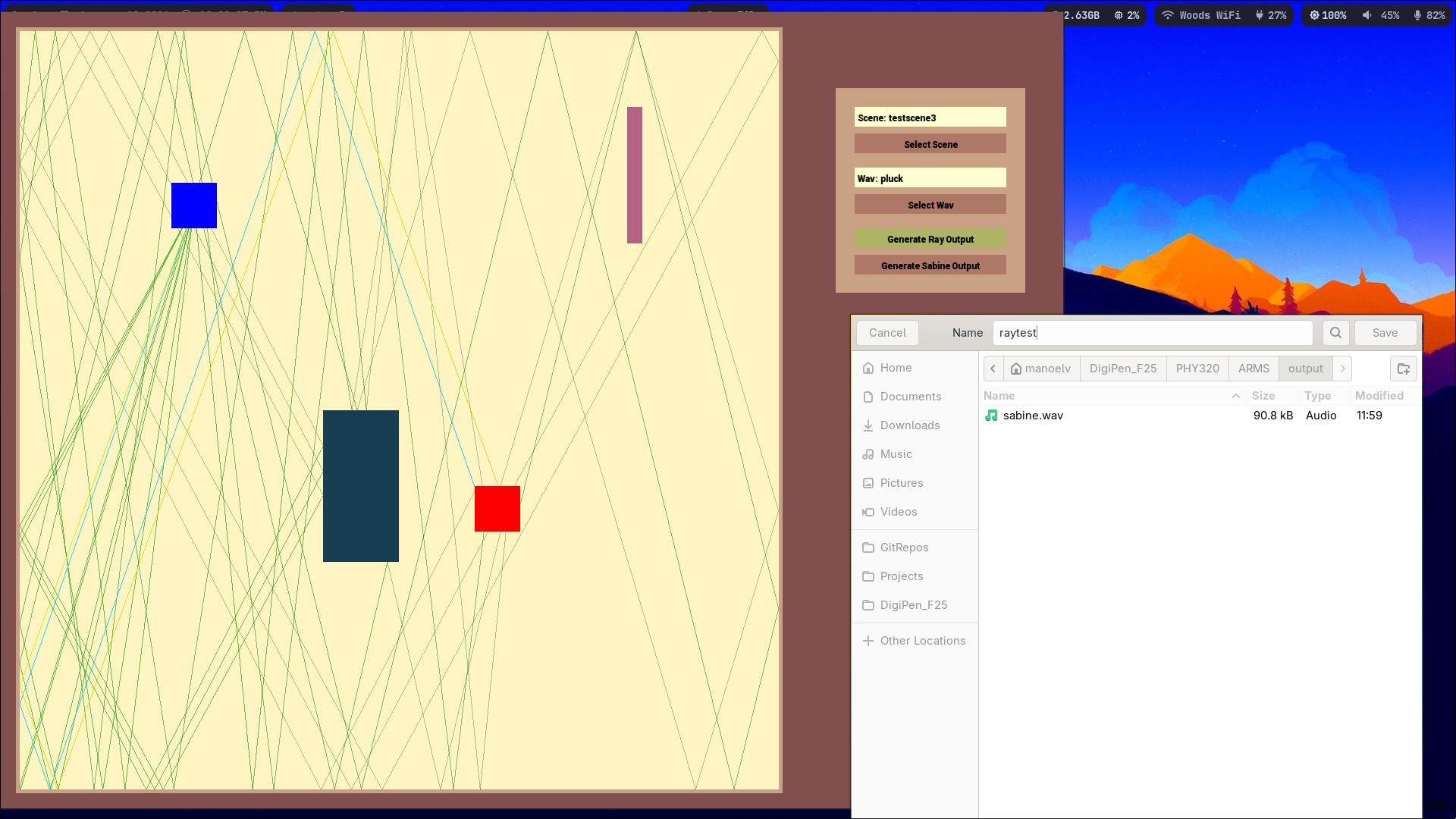
Acoustic Ray Modeling Simulation (ARMS)
A Physically Modeled Acoustic Room
Simulation
that visualizes and filters audio files
based on how rooms attenutate sound due to
different materials, and microphone/speaker
settings. Check it out on Github!
Key features:
- .wav file I/O for digitally
processing samples to simulate them within given rooms
- Physical ray modeled reverberance
- Schroeder (Sabine Formula) modeled reverberance
- Built using SFML to visualize rooms
and their physically modeled rays
- Custom scripting system with
features such as:
- Custom material creation
- Custom room generation
- Customizable microphone
settings
- Customizable speaker
settings
JUCE Moore Reverb
A JUCE application built for testing, visualizing,
and applying Moore Reverb to user files.
Key features:
- .wav file I/O
- Moore Reverb DSP
- Impulse Respone Graph
- Real-Time Parameter Control
Cretaceous Clash
A 2D robot-and-dinosaur-themed turn-based strategy
game built in C/C++ on a five-person team between September 2024
- April 2025 using our own custom engine.
While this project has completed its lifecycle as a school assignment,
my team and I are currently refining and polishing it for a planned Steam
release in Summer 2026.
Contributions include:
- A custom OpenGL/GLFW based graphics
system
- Custom shaders
- Batch rendering
- Depth drawing
- TrueType font support
- 2D Meshes and Textures
- A custom FMOD based audio system (with
code samples below!)
- Auto-ducking music to bring out SFX
- Seamless fading between themed-variations of tracks
- Lowpass filtering system on focus loss or menu activation
- Adaptive beat tracking
- Designed, recorded, and implemented SFX/Music
- Level selection system to allow for
replayability
- Used JSON through JSON For Modern C++
to serialize all entities, components, and
scenes
- Led task management and tracking for
the team
- Wrote up a technical specification
providing a high overview of our engine and
its systems
WebSynth
A browser-based polyphonic synthesizer
using p5.js that features four distinct waveforms
and real-time visualization. While initially
developed as a tool to help teach high school
students the basics of programming, it evolved into
a personal project exploring audio synthesis
through visualization.
Key features:
- 4 selectable waveforms
- Polyphonic playback for chords and
harmonies
- Interactive drag and drop GUI
- MIDI-style input using a standard
computer keyboard
- Live visualization of frequency,
amplitude, and MIDI note data
A key technical challenge I faced during this
project was attempting to mitigate the audible
'clicks' from oscillators as they started and stopped
While I implemented solutions such as amplitude
ramping and ADSR envelopes, I found that the
key issue lay within the lack of granular control
given through the p5 framework. Through this
experience I have learned valuable information in
synthesis visualization and look forward to
re-implementing this through C++ and portaudio
and/or juce in the future to gain greater control
over the audio stream and produce seamless output.
Rogue Waters
A 2D procedurally generated pirate-themed
rogue-like built in C/C++ on a three-person team
between January - May 2024 using our own custom engine
and the DigiPen Graphics Library.
Contributions include:
- Grid-based level generation where the values of each index corresponded to a tile type
- Procedural level generation with focus on ensuring all enemies were accessible by the player
- Collision between player and level objects based on tile types
- Player controller, stats and behaviors
- UI to indicate health and level time remaining
- Health system that gave player health back based on if all enemies were killed
- Combat system between player and enemies
- Three enemy types with different stats to add variety to gameplay and levels
- SFX/Music design and implementation
Nomentum
A 2D momentum-based platformer built in C on a
three-person team between October - December 2023 using
DigiPen's own C Processing framework.
Contributions include:
- Tile-based level builder
- Physics and collision system to handle
complex platforming mechanics
- Debug drawing for all interactable objects
- Enviornmental interactions such as doors,
levers, spikes, slimes, and level clear flags
- A timer system for keeping track of the length
of each session to encourage replayability
- Final boss level map, gameplay,
and boss behavior
- SFX/Music design and implementation